
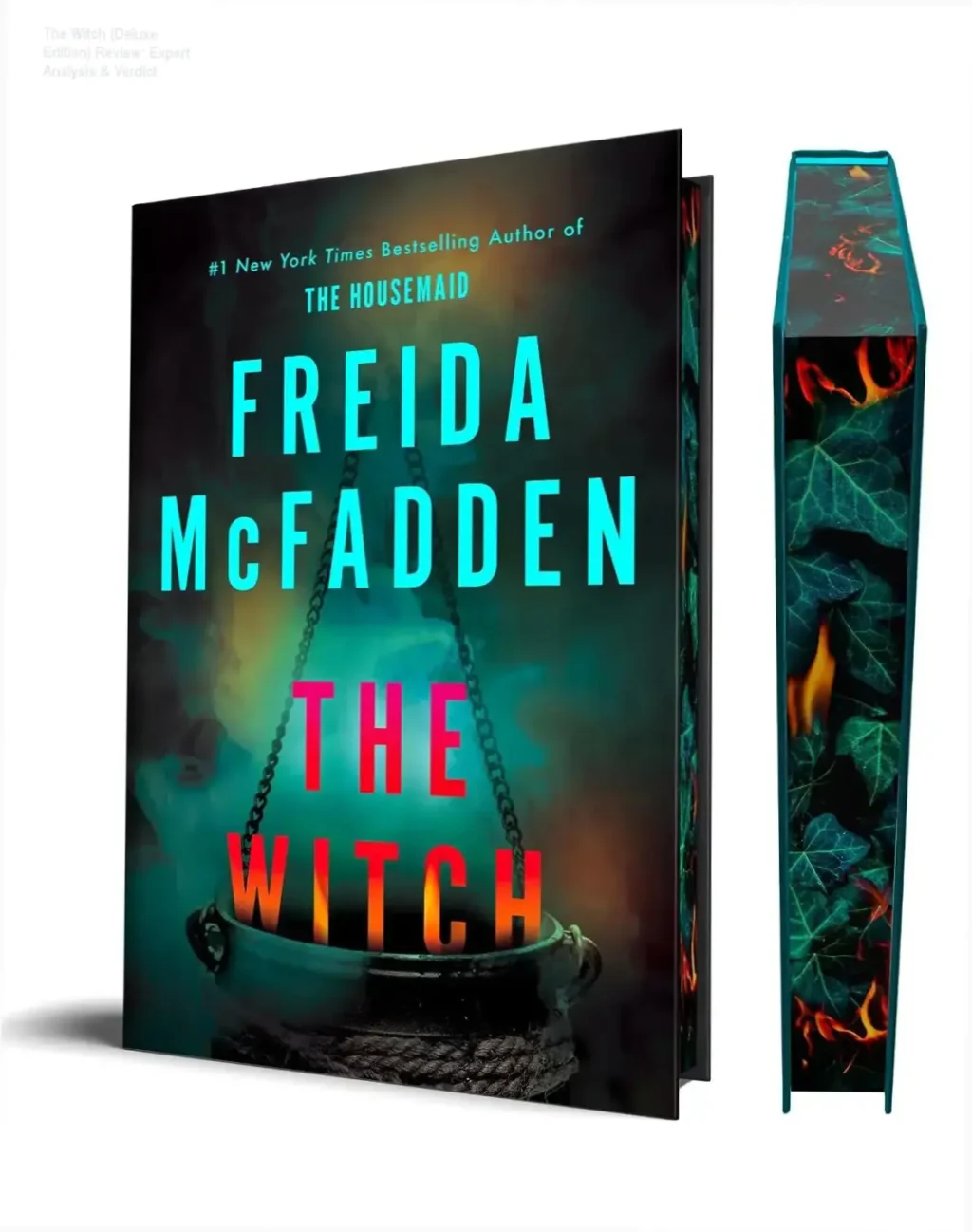
Freida McFadden has built an empire on a very specific promise: you will read her books in a single sitting, usually against your better judgment regarding sleep schedules. The problem for the returning reader isn’t quality control—she is remarkably consistent—it’s the creeping sense of déjà vu. We know the architecture: the unreliable narrator, the domestic pressure cooker, the final-act rug pull. The Witch (Deluxe Edition) arrives with a twist on that formula, swapping the suburban split-level for a seventeenth-century Massachusetts estate named Pemberton. The marketing leans hard into “gothic thriller,” a label that raises immediate skepticism for an author defined by modern, clinical tension.
The central question isn’t whether McFadden can write a page-turner; she effectively invented the current commercial iteration of the genre. The question is whether she can sustain atmosphere without her usual propulsive, dialogue-heavy shorthand. A haunted house requires patience. It demands sensory details—creaking floors, temperature drops, the weight of history—that often get trimmed in favor of pacing. Early reader chatter on advanced copies suggests a split verdict: the atmosphere is thicker, but the “McFadden DNA” remains unmistakable. The Deluxe Edition packaging signals a publisher betting on collectibility, but the real test is whether the hardcover format elevates a story that usually lives in disposable paperback speed.
Ready to dive into “The Witch (Deluxe Edition)”?
Explore available editions, check current live pricing, or download a free sample directly on Amazon.
Preview Free Sample & Check Price on Amazon
*You will be redirected to Amazon. As an Amazon Associate, we may earn from qualifying purchases.
Writing Style: Clinical Prose Meets Gothic Texture
McFadden’s signature style is utilitarian. Short sentences. Subject-verb-object. Zero literary fat. It creates a velocity that makes 352 pages vanish in three hours. The Witch retains this engine but bolts on a heavier chassis. The prose spends more time describing the smell of rot in the walls, the specific angle of light through leaded glass, the heaviness of the air. It works, mostly. The first hundred pages are the strongest pure “writing” she has published. You feel the damp cold of Pemberton.
Then the plot kicks in, and the style reverts to type. Dialogue becomes purely functional—exposition delivery vehicles. Internal monologue cycles through the same three anxieties repeatedly. A Reddit user on r/thrillerbooks noted, “It reads like a standard McFadden book wearing a vampire cape.” That is unfair but accurate. The gothic elements are set dressing. The core mechanic remains: Information Withholding -> Revelation -> Recontextualization. If you love that loop, the style serves it perfectly. If you wanted Rebecca or The Turn of the Screw, the modern thriller syntax will feel jarring.
Pacing is ruthless. Chapters end on micro-cliffhangers. The grandfather clock stopping at 3:41 a.m. is a classic McFadden “tick”—a concrete, audible detail anchoring the supernatural in the mundane. It forces the reader forward. The Deluxe Edition’s larger trim size (6.25 x 9.25 inches) and heavier paper stock actually slow the physical act of turning pages slightly, a subtle but real friction against the narrative velocity. It forces a micro-pause that the mass market paperback eliminates.
Narrative Structure: The Dual Timeline Gamble
The structure splits between Julia in the present day and the historical record of the 1692 witch execution. This is not a spoiler; it’s the premise. The risk with dual timelines in commercial thrillers is imbalance. Usually, the historical sections feel like homework—necessary backstory dumped between the “real” action. McFadden avoids this by making the 1692 sections shorter, punchier, and narratively tighter than the modern plot. The accused woman, Eliza, gets a distinct voice. It lacks the anachronistic “modern voice in period drag” problem plaguing much historical fiction.
The convergence is mechanical. Julia finds a diary. She reads an entry. The narrative jumps to that entry. It is functional, not artistic. Goodreads reviewers frequently cite the “predictability of the structure” as a negative. “I knew exactly when the timeline would switch,” wrote one verified purchaser. “It kills the mystery of the past.” They aren’t wrong. The structure signals its own beats. However, the content of the reveals—specifically regarding the Barlow family lineage—subverts the structural predictability. The “why” matters more than the “when.”
A notable structural choice: The “twist” arrives roughly at the 70% mark, earlier than the standard 85-90% McFadden special. This shifts the final act from “shock” to “consequence.” We watch the fallout. It’s a smarter, more satisfying shape for a gothic story, which is ultimately about the weight of the past crushing the present. The Deluxe edition includes a family tree diagram in the front matter. Keep it bookmarked. You will need it.
here.
Final Editorial Verdict“The Witch (Deluxe Edition)” delivers on its core promise for its intended audience, offering compelling insights without fluff. As highlighted in our detailed edition breakdown, its practical depth and readability are its greatest strengths. We also recommend checking the official Kindle sample and reader ratings before making your final purchase decision. *You will be redirected to Amazon. As an Amazon Associate, we earn from qualifying purchases.  Related Posts

|
|---|