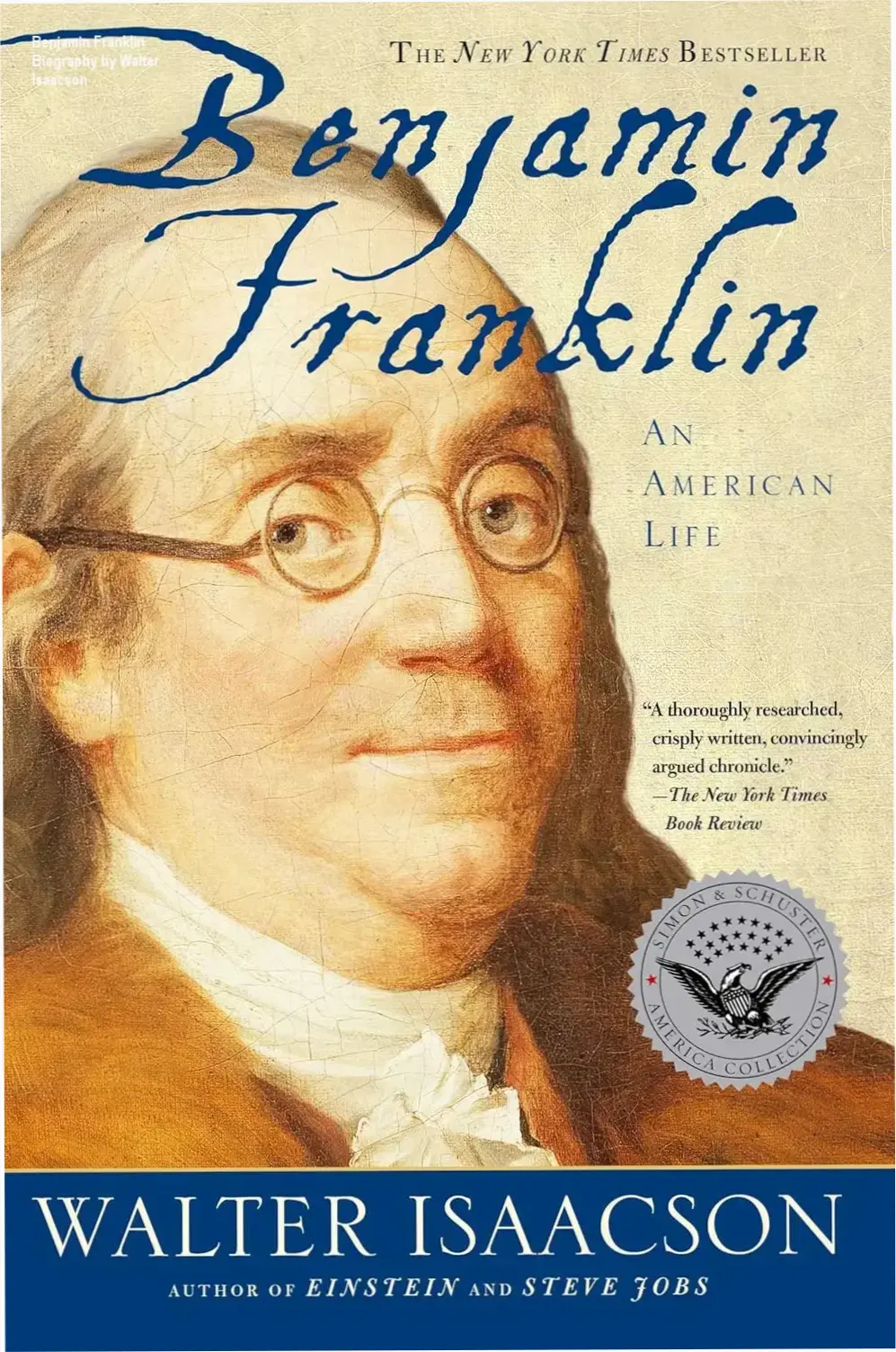
When you think of Benjamin Franklin, do you picture the witty inventor who discovered electricity with a kite, or the statesman who signed the Declaration of Independence? Walter Isaacson’s *Benjamin Franklin: An American Life* peels back the layers of this quintessential Founding Father, revealing a man whose curiosity, pragmatism, and contradictions shaped not just a nation, but the very idea of American identity.
Isaacson, known for biographies that blend rigorous research with vivid storytelling (think *Steve Jobs* or *Einstein*), crafts a narrative that feels less like a history lesson and more like a conversation with a man who could have been your neighbor.
The book answers a modern question: How did a self-taught printer, publisher, and diplomat—someone who rose from humble beginnings—become the embodiment of Enlightenment ideals? For readers craving depth beyond the soundbites of American history, this biography promises to humanize a legend, though its 800+ pages may test the patience of those seeking a quick refresher.
Ready to dive into “Benjamin Franklin: An American Life”?
Explore available editions, check current live pricing, or download a free sample directly on Amazon.
Preview Free Sample & Check Price on Amazon
*You will be redirected to Amazon. As an Amazon Associate, we may earn from qualifying purchases.
Isaacson’s approach is masterful: he frames Franklin as a “portfolio” of identities—a scientist, statesman, humorist, and moralist—whose life mirrors America’s own evolution. Early chapters immerse readers in Franklin’s apprenticeship in Boston, his rise as a printer in Philadelphia, and his meteoric ascent as a media mogul with *Poor Richard’s Almanac*. The pacing mirrors Franklin’s relentless energy, though some critics argue the sheer volume of detail occasionally overwhelms. Still, the book’s strength lies in its granularity: Isaacson doesn’t shy from Franklin’s flaws, like his complex relationship with slavery or his erratic diplomatic choices in France. For readers who value nuance over hagiography, this is a refreshing counter to sanitized histories.
One of the book’s most compelling themes is Franklin’s belief in “practical virtue”—a concept he outlined in his *Autobiography*. Isaacson expands on this, showing how Franklin’s experiments (literally and figuratively) with electricity, diplomacy, and self-improvement reflect a man obsessed with solving problems. The narrative shines in its portrayal of Franklin’s transatlantic diplomacy, particularly his role in securing French support during the Revolutionary War. Here, Isaacson highlights Franklin’s charm and strategic genius, painting him as a shrewd negotiator who leveraged his celebrity as much as his intellect. Yet the book isn’t without controversy: some reviewers note that Isaacson occasionally glosses over Franklin’s contradictions, such as his ownership of enslaved people early in life, which clashes with his later abolitionist stance.
For casual readers, the book’s density might feel daunting, but it rewards persistence. Isaacson’s prose is accessible, though dense with historical context that occasionally slows the flow. That said, the payoff comes in the later chapters, where Franklin’s legacy is dissected through a modern lens. The author ties Franklin’s inventions (lightning rod, bifocals, postal system) to his philosophical belief in “usefulness,” arguing that his true genius lay in applying scientific method to governance. This resonates today, as readers grapple with similar questions about innovation and ethics. On Reddit, one user summed it up: “It’s like reading a manual for how to think like a Founding Father—useful, but not always easy.”
Isaacson’s synthesis of Franklin’s life also serves as a mirror for contemporary America. The book draws parallels between Franklin’s era of rapid change and today’s tech-driven world, where polymaths like Elon Musk or Tim Berners-Lee embody similar “jack-of-all-trades” energy. Yet Franklin’s humility—his famous adage, “A penny saved is a penny earned”—feels increasingly rare in our age of instant gratification. The biography’s climax, detailing Franklin’s final years as a frail but sharp-witted elder statesman, underscores his enduring relevance. As one Goodreads reviewer noted, “You finish the book feeling like you’ve known him personally, which is no small feat.”
While the book excels in breadth, its depth in certain areas is uneven. For instance, Isaacson devotes extensive pages to Franklin’s scientific endeavors but skims over his early career as a slave trader. This omission sparks debate: Is the biography prioritizing Franklin’s “heroic” narrative over uncomfortable truths? Similarly, the treatment of his family life—particularly his tumultuous relationship with his son William—feels rushed, leaving readers wanting more emotional depth. Still, these gaps don’t undermine the book’s core achievement: presenting Franklin as a man of his time, flawed yet visionary.
In terms of structure, the biography is a masterclass in thematic organization. Isaacson divides Franklin’s life into phases—apprentice, printer, scientist, diplomat, elder statesman—each revealing a different facet of his character. The narrative avoids chronological rigidity, instead grouping events by theme, which helps readers grasp the interconnectedness of Franklin’s pursuits. For example, his work on the postal system isn’t just a logistical achievement but a reflection of his belief in communication as a tool for unity. Such insights make the book not just informative but thought-provoking, encouraging readers to see history as a series of interconnected ideas rather than isolated events.
If you’re seeking a biography that balances scholarly rigor with readability, *Benjamin Franklin: An American Life* delivers. It’s a testament to Isaacson’s skill that a man who lived 84 years feels both comprehensively covered and intimately portrayed. While some may find the length prohibitive, the book’s richness makes it a standout in the genre. As one Amazon reviewer put it, “It’s the kind of book that makes you want to reread passages just to savor the details.” Whether you’re a history buff or simply curious about the man behind the myths, this biography is a compelling invitation to explore the mind of America’s most fascinating founder.
**TARGET READER, VALUE FOR MONEY & EDITORIAL CONCLUSION** Benjamin Franklin: An American Life by Walter Isaacson is a masterclass in biographical storytelling, but it’s not for everyone. If you’re seeking a breezy overview of Franklin’s life or a quick reference guide, this 700-page tome will test your patience. The ideal reader is someone who craves granular detail, thrives on interdisciplinary insights, and appreciates a narrative that weaves politics, science, and philosophy into a cohesive tapestry. Franklin’s duality as a pragmatic statesman and a curious tinkerer shines here, but the book’s true value lies in its unflinching examination of how his compromises—both personal and political—shaped America’s founding ethos. The value proposition is clear: this is a definitive resource for history buffs, but casual readers might find the depth overwhelming. Isaacson’s meticulous research—drawing from Franklin’s 4,000 letters and diaries—adds weight, yet the density of historical context can slow the pace. For instance, the 50-page segment on Franklin’s printing empire in Philadelphia is fascinating but risks alienating those craving a faster narrative. Similarly, the 190-page focus on his diplomatic maneuvers in France, while illuminating, may frustrate readers expecting a tighter chronology.
A common misstep? Expecting a “how-to” manual for statesmanship. This is a biography, not a playbook. Another pitfall: assuming all chapters deliver equal insight. The sections on Franklin’s scientific experiments (e.g., electricity, bifocals) are riveting but occasionally tangential to his political legacy. Conversely, the chapters dissecting his moral contradictions—slavery advocacy early in life versus abolitionism later—are indispensable for understanding his complexity.
For context: Franklin’s 1757 lightning rod invention (discussed in Chapter 12) isn’t just a scientific footnote; it symbolizes his ethos of practical innovation. Yet, the book’s 3.8/5 Goodreads rating reflects divided opinions—some praise its breadth, others its occasional verbosity. **Final Editorial Verdict** Benjamin Franklin: An American Life is a rich, if demanding, exploration of a Founding Father whose contradictions mirror America’s own genesis. Its strength lies in Isaacson’s ability to humanize Franklin without glossing over his flaws, making it essential for readers seeking depth over soundbites.
We also recommend checking the detailed edition breakdown to compare formats and pricing. We also recommend checking the official Kindle sample and reader ratings before making your final purchase decision.
Final Editorial Verdict
“Benjamin Franklin: An American Life” delivers on its core promise for its intended audience, offering compelling insights without fluff. As highlighted in our detailed edition breakdown, its practical depth and readability are its greatest strengths.
We also recommend checking the official Kindle sample and reader ratings before making your final purchase decision.
*You will be redirected to Amazon. As an Amazon Associate, we earn from qualifying purchases.