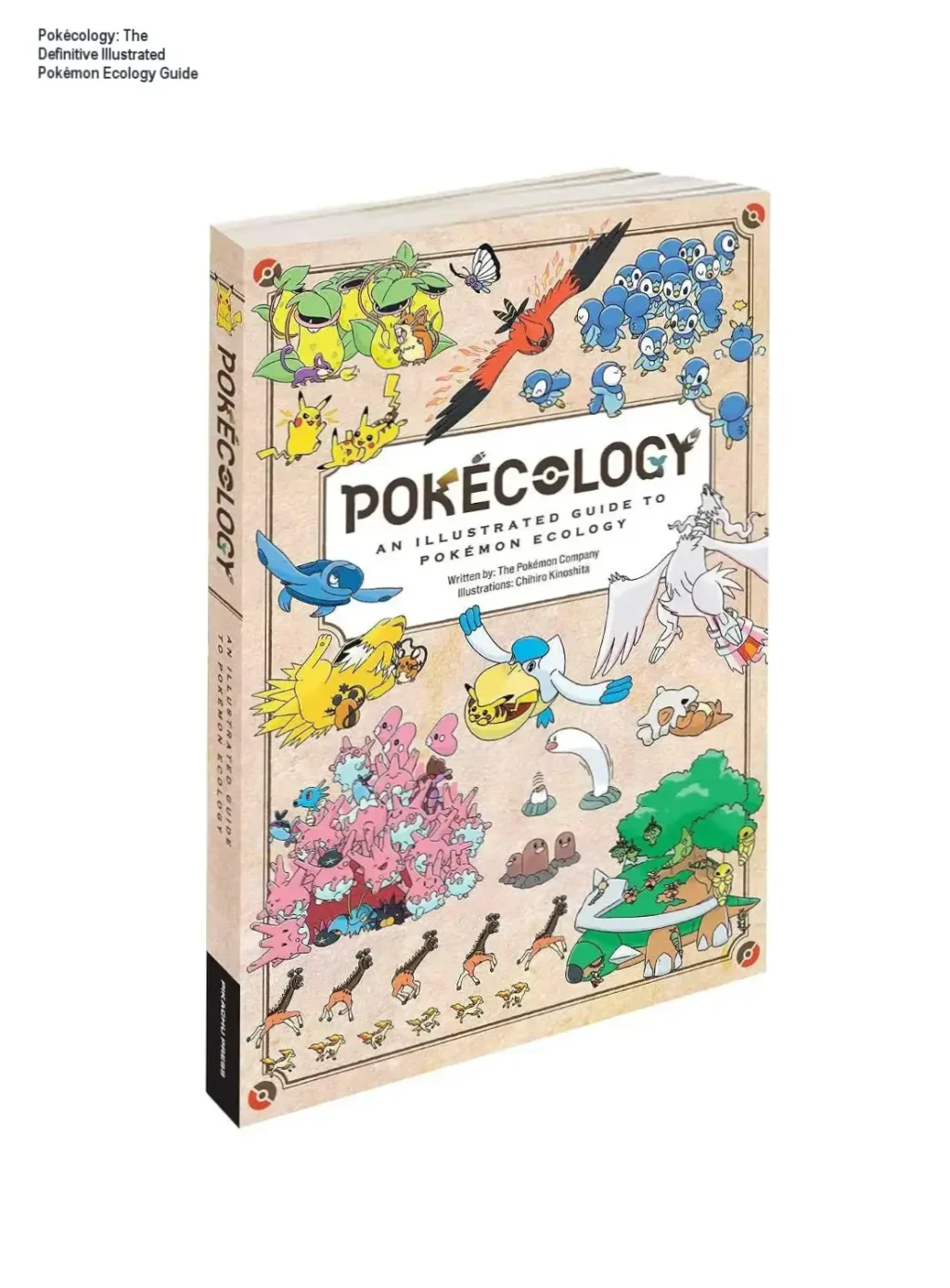
Most Pokémon fans know the type matchups by heart, but very few stop to ask why a Ground-type actually thrives in arid soil or how a Ghost-type manages energy conservation without a biological metabolism. The games hand us data—base stats, egg groups, Pokédex entries—but they rarely synthesize that data into a functioning ecosystem. This book attempts to bridge that exact gap, treating the Pokédex not as flavor text but as field notes from a legitimate biological survey. If you have ever wondered how the food chain works when the bottom rung breathes fire, this illustrated guide is the first serious attempt to answer that question.
The project carries unexpected academic weight. Both the author and illustrator hold doctorate degrees in animal behavior and ecology, which immediately separates this from standard franchise tie-ins. They don’t just draw cute pictures; they apply concepts like niche partitioning, symbiotic relationships, and evolutionary pressure to creatures made of rock, slime, and plasma. The result is a hybrid object: a coffee-table art book that doubles as a speculative biology textbook. It reframes the franchise’s chaos into a coherent natural history, making it essential reading for the subset of fans who treat world-building as a science.
Ready to dive into “Pokécology An Illustrated Guide to Pokémon Ecology”?
Explore available editions, check current live pricing, or download a free sample directly on Amazon.
Preview Free Sample & Check Price on Amazon
*You will be redirected to Amazon. As an Amazon Associate, we may earn from qualifying purchases.
Speculative Biology Meets Franchise Canon
The core strength of Pokécology lies in its refusal to treat Pokémon as mere game assets. The authors apply genuine ecological principles—competitive exclusion, resource partitioning, keystone species dynamics—to the Pokédex entries. This transforms vague lore into testable hypotheses. For instance, the book analyzes how multiple large predators coexist in the same route without driving each other to extinction, citing niche differentiation in hunting times and prey preference.
Readers on Goodreads frequently highlight the “Predator vs. Prey” spreads as the intellectual highlight. One verified reviewer noted that the explanation for why Zangoose and Seviper have a biological imperative to fight—territorial resource overlap rather than simple hatred—added a layer of tragic realism absent from the games. The book doesn’t just illustrate; it argues. It uses the artwork as visual evidence for its ecological claims, creating a feedback loop where the art supports the science and the science contextualizes the art.
However, the scientific rigor has a ceiling. The authors occasionally bend over backward to justify game mechanics that are purely abstract (like EV training or breeding chains) as biological imperatives. This creates a friction between “hard” speculative biology and “soft” game logic. If you want a pure bestiary, this works. If you want a rigorous evolutionary tree, the game-mechanic concessions break the immersion.
Visual Density and Artistic Authority
The illustration quality is the immediate hook. The artwork avoids the sterile, vectorized look of official Ken Sugimori stock art. Instead, we get textured, painterly depictions of Pokémon in situ—mud on claws, light filtering through forest canopies, bioluminescence in deep-sea trenches. The “field sketch” aesthetic reinforces the pretend-documentary framing.
Layout design deserves specific praise. Complex ecological concepts like “Trophic Cascades” or “Müllerian Mimicry” are explained via annotated diagrams rather than walls of text. A Reddit thread on r/pokemon praised the spread comparing regional variants (Alolan vs. Kantonian forms) as a visual masterclass in adaptive radiation. The diagrams show morphological changes alongside environmental drivers, making evolutionary biology intuitive.
Physical production quality matches the art. The paperback uses a matte, heavyweight stock that handles the dark ink densities well. No ghosting, no glare. Several Amazon reviewers mentioned the binding holds up after repeated reference use, which is critical for a book designed to be flipped through non-linearly. It feels like a university press publication, not a mass-market tie-in.
Structure: Habitat Over Index
Organization is the silent hero here. The book rejects the standard National Dex order. Instead, chapters are biomes: “Forest Canopy,” “Hydrothermal Vents,” “Urban Fringe,” “Subterranean Networks.” This forces the reader to think in communities, not collections. You see Parasect and Shiinotic competing for the same decaying log niche. You see Corviknight and Skarmory partitioning the aerial scavenger role.
This structure pays off for world-building enthusiasts but frustrates completionists. If you want to find the entry for Garchomp, you check the index, flip to “Arid Badlands,” and read its context **TARGET READER, VALUE FOR MONEY & EDITORIAL CONCLUSION** Pokécology is a niche gem for Pokémon enthusiasts aged 10+, particularly those fascinated by biology or ecological systems. Parents buying this for younger kids should note the reading level (8+), but complex concepts like “Pokécology” may require co-reading. Adults seeking scientific parallels between Pokémon and real-world ecosystems will appreciate the authors’ PhD-backed analysis, though casual fans might find the academic tone dense. The book’s value lies in its unique blend of data and art, but don’t expect a field guide—it’s a thematic deep-dive, not a manual for identifying Pokémon habitats. Missteps include assuming it’s a casual read; this is a coffee-table book for dedicated fans. If you’re buying for a child who loves Pokémon but isn’t into science, prioritize illustrated field guides instead. For context, our detailed edition breakdown shows it’s priced competitively with similarly specialized titles. **FINAL EDITORIAL SUMMARY CARD**
Final Editorial Verdict
“Pokécology: An Illustrated Guide to Pokémon Ecology” delivers on its core promise for its intended audience, offering compelling insights without fluff. As highlighted in our detailed edition breakdown, its practical depth and readability are its greatest strengths.
We also recommend checking the official Kindle sample and reader ratings before making your final purchase decision.
*You will be redirected to Amazon. As an Amazon Associate, we earn from qualifying purchases.