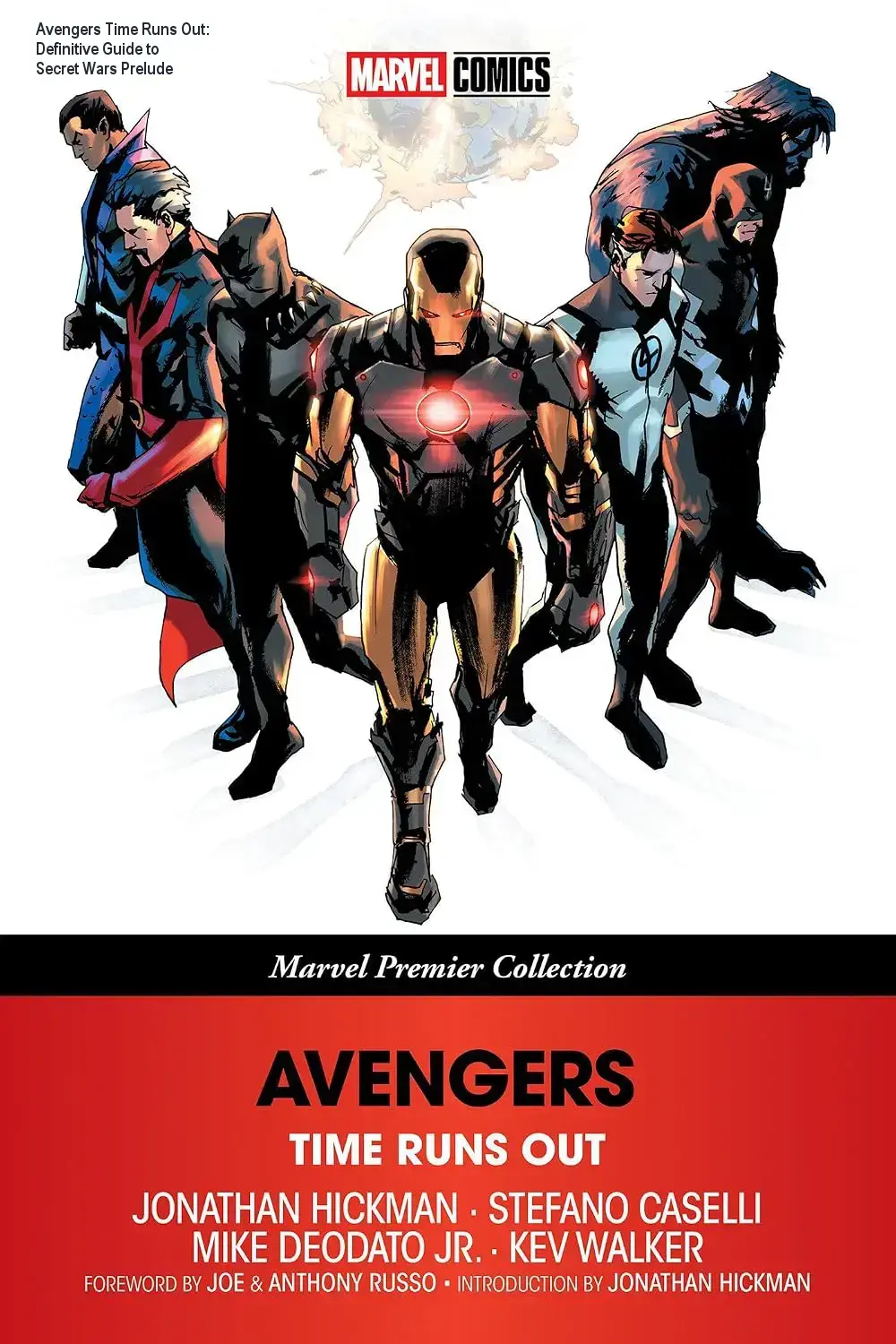
Jonathan Hickman’s Avengers run is often cited as the gold standard for modern cosmic storytelling, yet it carries a reputation for density that scares off casual readers. The problem isn’t the concepts — incursions, mapmakers, the Black Priests — it’s the sheer volume of moving parts spread across two concurrent titles. You need a roadmap just to find the starting line. This collection solves that structural headache by stitching Avengers #35–44 and New Avengers #24–33 into a single, chronological narrative. It is the definitive “Time Runs Out” arc, the desperate sprint toward Secret Wars. If you’ve ever wondered what happens when Earth’s Mightiest Heroes actually lose, this is the autopsy. You can check the current edition details here.
The Marvel Premier Collection format promises a premium reading experience for a paperback price point. That matters because Hickman’s scripts demand space to breathe; the double-page spreads by Stefano Caselli and Mike Deodato Jr. lose impact in standard digest sizes. This volume collects the endgame. The Illuminati have been exposed. The Avengers are hunting their former friends. Tony Stark and Steve Rogers are on a collision course that has been building for fifty issues. It is bleak, intellectual, and visually stunning.
Ready to dive into “Avengers: Time Runs Out [Marvel Premier Collection]”?
Explore available editions, check current live pricing, or download a free sample directly on Amazon.
Preview Free Sample & Check Price on Amazon
*You will be redirected to Amazon. As an Amazon Associate, we may earn from qualifying purchases.
Narrative Architecture: Two Books, One Pulse
Reading Avengers and New Avengers monthly in 2015 required mental gymnastics. You jumped from the high-concept sci-fi of the main team (Builder wars, Ex Nihilo, Starbrand) to the grim, philosophical bunker meetings of the Illuminati. This collection eliminates the whiplash. It interleaves the issues chronologically.
The result is a masterclass in pacing. The “eight months later” time jump — a notorious frustration for single-issue buyers — flows naturally here. You feel the exhaustion. The gaps between incursions aren’t missing pages; they are the silence between heartbeats. Hickman structures the collapse like a procedural. Scene A: Science fails. Scene B: Morality breaks. Scene C: The punch lands.
Reddit threads on r/comicbooks frequently cite this specific reading order as the “only way to read it.” Users note that the monthly wait killed the tension; the trade wait rewarded it. The narrative density is high, but the throughput is smooth. You aren’t flipping back covers to check issue numbers. You are just watching the world end.
Art Rotation as Narrative Device
Five primary pencillers share the load: Caselli, Deodato Jr., Mayhew, Schiti, Walker, Kudranski, Talajić. In a lesser edition, this signals chaos. Here, it signals scope. Caselli handles the clean, futuristic sheen of the Avengers’ space opera. Deodato brings the grit, the shadows, the weight of the Illuminati’s war room. Valerio Schiti adds a kinetic, almost manga-influenced energy to the combat sequences.
The Premier Collection paper stock (matte, heavy) handles the transitions well. Colors by Frank Martin and Justin Ponsor unify the palette. The “Incursion red” bleeds through both titles. It’s a visual cue: universes are dying. A common complaint on Goodreads regarding the previous hardcovers was muddy printing on Deodato’s inks. This paperback run avoids that trap. The contrast holds. The blacks stay black.
The Illuminati Problem: Ethics at Gunpoint
This is the thematic core. The “Time Runs Out” label isn’t just about the multiverse clock. It’s about the runway for moral compromise. The Illuminati (Stark, Strange, Black Bolt, Namor, Reed, T’Challa, Beast) have been blowing up Earths to save theirs. The main Avengers team finds out. The fracture is immediate.
Hickman refuses easy answers. Captain America isn’t “right.” Tony Stark isn’t “wrong.” They are both insufficient. The New Avengers issues in this volume — specifically the “Cabal” arc where Namor forms a villain team to do the dirty work — are brutal. Namor becomes the monster so the heroes don’t have to be. Except they already were.
Amazon verified purchasers often highlight the “Cabal” issues as the emotional peak. One reviewer wrote: “It breaks the binary. You realize the ‘heroes’ ran out of heroic options 20 issues ago.” That sentiment echoes across forums. The book forces you to sit in the discomfort of utilitarianism. It ages remarkably well in an era of trolley-problem politics.