Most of us spend our days navigating a predictable, often draining routine. We crave a door out—not just a vacation, but a complete psychological shift into a world where stakes are visceral and emotions are raw.
The “Romantasy” boom isn’t just a trend; it’s a reaction to a world that feels increasingly sterile. Sarah J. Maas tapped into this by blending brutal politics with intense emotional intimacy. If you’ve been hesitant about the hype, you can check the current reader reception to see why millions are obsessed with this specific saga.
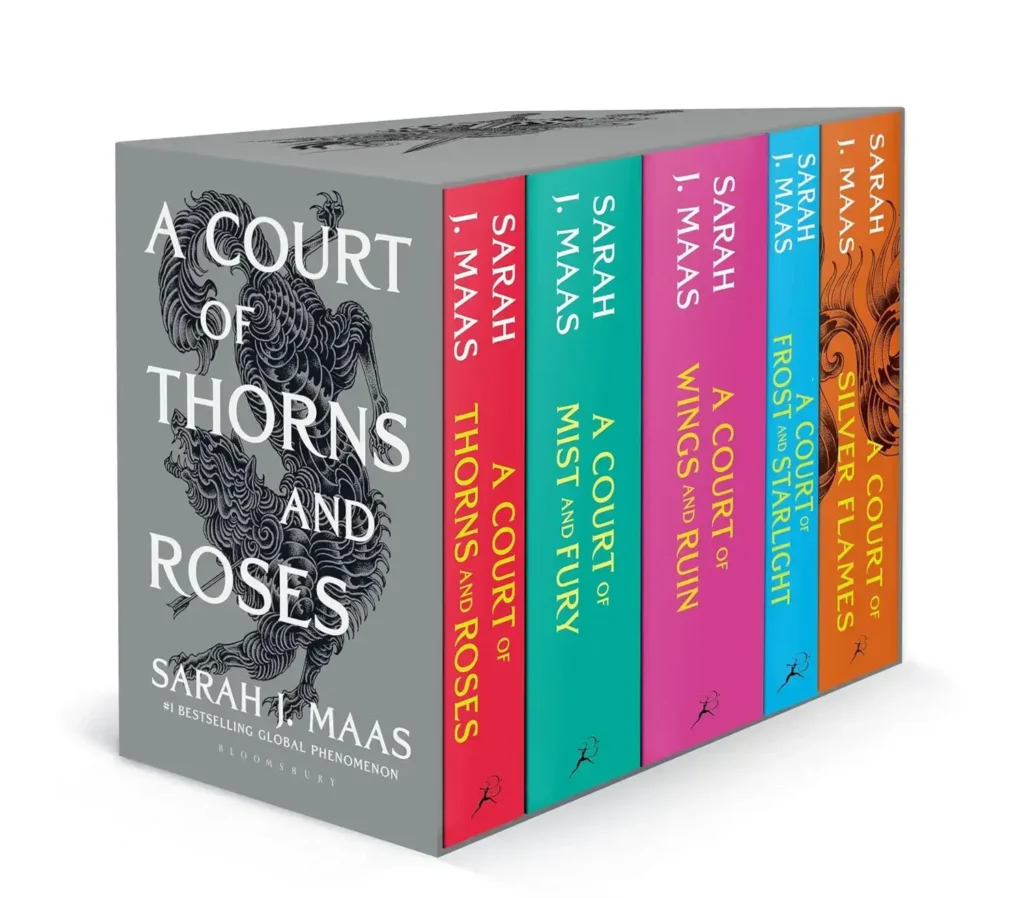
Ready to dive into “A Court of Thorns and Roses”?
Explore available editions, check current live pricing, or download a free sample directly on Amazon.
Preview Free Sample & Check Price on Amazon
*You will be redirected to Amazon. As an Amazon Associate, we may earn from qualifying purchases.
The “Bait and Switch” Narrative Structure
Let’s be honest: the first book, A Court of Thorns and Roses, feels like a standard Beauty and the Beast retelling. It’s functional, it establishes the world, and it sets the stakes. But it’s almost a decoy.
The real brilliance—and the reason this series exploded on TikTok and Reddit—happens in the second installment, A Court of Mist and Fury. Maas executes a narrative pivot that catches most readers off guard.
She shifts the focus from a simple survival story to a complex study of trauma, manipulation, and the difference between “protective” love and “empowering” love. This transition is what elevates the series from generic fantasy to a cultural phenomenon.
For the skeptical reader, the first book might feel slow. However, the payoff is structural. You have to endure the initial tropes to reach the psychological depth of the later volumes.
Writing Style: High Emotion, Low Friction
Sarah J. Maas doesn’t write for the literary elite. Her prose is designed for momentum. It is fluid, emotive, and intentionally immersive.
She focuses heavily on sensory details—the scent of citrus and sea salt, the feel of velvet, the tension in a room. This “sensory anchoring” is why readers report feeling “lost” in the books.
Critics often point to her repetitive phrasing or occasional melodrama. From an analytical standpoint, this is a feature, not a bug. It creates a rhythmic, almost hypnotic reading experience that facilitates binge-reading.
The pacing varies wildly. You’ll have 100 pages of political maneuvering followed by 50 pages of high-octane violence and passion. It mimics the emotional volatility of its characters.
“The series doesn’t just tell a story; it triggers a visceral emotional response. Whether you love it or hate it, you cannot remain indifferent to the tension Maas builds.”
Trauma and Resilience: The Real-World Value
Beyond the wings and magic, the series is an accidental masterclass in depicting PTSD. Feyre’s journey isn’t just about fighting monsters; it’s about the crushing weight of survival guilt.
The way the narrative handles Feyre’s depression in the second book is surprisingly nuanced. It doesn’t “cure” her with a new romance; instead, it shows a slow, painful process of reclaiming agency.
Then there is Nesta. In A Court of Silver Flames, Maas tackles the “unlikable female character” trope. Nesta is abrasive, cruel, and broken.
Watching her navigate her own self-loathing provides a mirror for readers who don’t see themselves in the “perfect” heroine. It turns a fantasy story into a study of mental resilience.