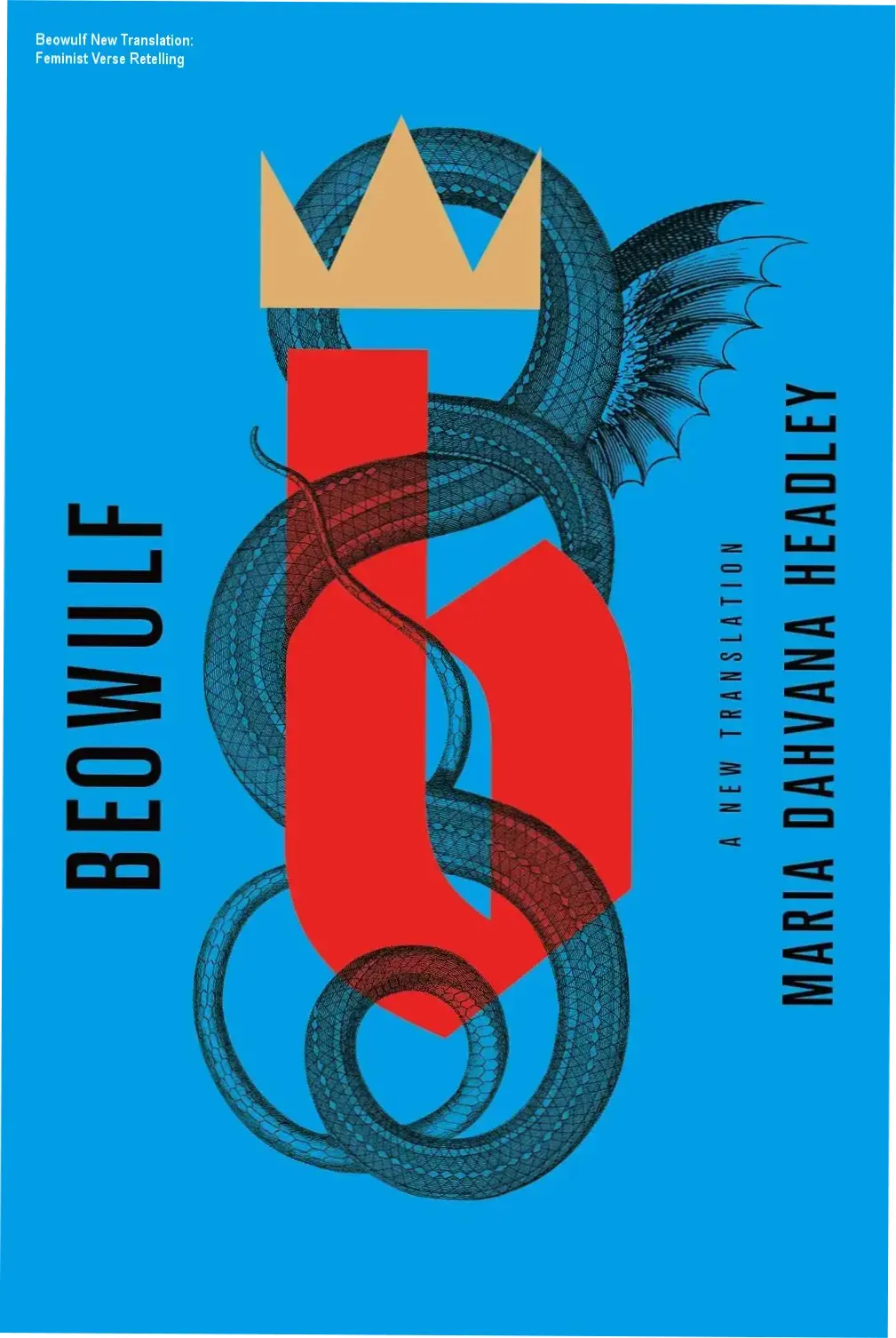
Most readers approach Beowulf with a sense of dread forged in high school English classes. We remember the dense, archaic syntax of translations past—lines that felt more like archaeological artifacts than living poetry. The problem isn’t the story; it’s the distance. For decades, the standard has been a choice between academic stiffness or loose, rhythm-less prose. Maria Dahvana Headley shatters that binary. She asks a simple question: what if the scop singing in the mead hall sounded less like a Victorian professor and more like a storyteller who knows the weight of a kenning and the sting of a subtweet? This translation doesn’t just update the vocabulary; it reclaims the poem’s original rowdy, oral energy. You can check the current edition details here to see how the presentation matches the content.
The result is a text that breathes. Headley uses modern idioms—”Bro,” “Hashtag,” “Wrecked”—not as gimmicks, but as functional equivalents to the Old English poetic compounds designed to shock or resonate instantly with a listening audience. It forces a confrontation with the text’s actual themes: toxic masculinity, the performance of heroism, and the terrifying proximity of the monster to the man. It is a translation that demands to be read aloud, preferably with a drink in hand.
Ready to dive into “Beowulf: A New Translation by Maria Dahvana Headley”?
Explore available editions, check current live pricing, or download a free sample directly on Amazon.
Preview Free Sample & Check Price on Amazon
*You will be redirected to Amazon. As an Amazon Associate, we may earn from qualifying purchases.
The Voice: Kennings Meet Keyboards
Headley’s most immediate victory is the voice. She translates the Old English hwæt—traditionally “Lo,” “Hark,” or “Behold”—as “Bro.”
It sounds like a stunt. It isn’t.
“Bro” functions exactly as hwæt did: a sharp, percussive demand for attention in a noisy room. It establishes the poem as oral performance, not silent study. The entire translation follows this logic. She uses “hashtag blessed” for sigora selest (best of victories). She renders the formal boasts as trash talk.
Critics on Goodreads and Reddit are split. One top reviewer calls it “cringe-inducing anachronism.” Another argues it’s “the only translation that made me understand why people listened to this for entertainment.” The friction is the point. Headley preserves the alliterative skeleton—feasceaft funden, he þæs frofre gebad—but drapes it in skin that feels warm right now.
The pacing accelerates because the friction of decoding vanishes. You stop translating in your head and start hearing the rhythm. It reads like a verse novel by way of a slam poem. That accessibility comes at a cost: the “timeless” patina is gone. You are always aware you are reading a 2020 interpretation of a 1000-year-old text. For some, that honesty is refreshing. For purists, it’s a betrayal.
The Feminist Lens: Grendel’s Mother Gets Her Due
Headley’s introduction is a manifesto. She argues centuries of male translators projected their own biases onto the text, flattening women into “peace-weavers” or monsters. She goes back to the manuscript.
The result? Grendel’s mother (ides aglæcwif) is no longer a “monstrous hell-bride.” Headley translates aglæcwif as “warrior-woman” or “formidable female fighter”—mirroring aglæca, used for Beowulf himself and Sigemund. The symmetry is deliberate. She is a grieving mother avenging her son under a legal code the poem respects. Beowulf kills her in her own hall, violating the sanctuary he claims to uphold.
This reframes the central conflict. It’s not Hero vs. Monster. It’s Power vs. Power. The dragon fight becomes the inevitable collapse of a system built on extraction and entitlement. Readers on r/books and r/translation frequently cite this shift as the translation’s intellectual core. “I never realized the poem was critiquing Beowulf until I read this,” is a common sentiment. Headley doesn’t insert feminism; she excavates it from the glosses previous translators ignored.
Translation Philosophy: Radical Fidelity Through Modernity
Headley defines her method as “radical fidelity.” She argues that a
Who Should Read This Translation
This edition targets readers who find traditional translations stiff or alienating. If you bounced off Heaney or Tolkien because the diction felt archaic, Headley’s voice feels immediate. She uses contemporary idiom — “Bro,” “hashtag,” “wrecked” — not as a gimmick, but to mirror the original poem’s own mix of high rhetoric and raw speech. Students facing a syllabus deadline will appreciate the velocity. The narrative moves fast.
Feminist readers and gender-studies scholars get a text that finally centers Grendel’s mother as a griever, not just a monster. The introduction alone is worth the price for its essay on translation ethics. Book clubs looking for debate fuel will find endless material in the choice to render ides aglæcwif as “warrior-woman” rather than “monstrous hell-bride.”
Who Should Skip It
- Purists wanting a line-for-line crib for Old English study. This is a poetic recreation, not a philological tool.
- Readers allergic to profanity. The f-word appears. Frequently. It serves the alliterative stress, but it jars if you expect “noble” epic tone.
- Audiobook-only consumers. The Kindle formatting handles the caesuras well; the audio experience loses the visual line-breaks that signal breath and violence.
Value Proposition & Common Missteps
At 178 pages, it’s slim. Don’t mistake brevity for slightness. The density of allusion — pop culture, queer theory, medieval scholarship — rewards rereading. A common misstep: buying the hardcover for the marginalia. The Kindle edition renders the facing-page notes cleanly via pop-up footnotes, saving shelf space and money. Another trap: expecting a “feminist rewrite.” It’s a feminist translation. The plot beats remain; the lens shifts. If you want a novelized expansion, read The Mere Wife instead.
For the price of a paperback, you get a Hugo-winning translation that functions as both a scholarly intervention and a page-turner. The ROI on intellectual stimulation per dollar is high. You can verify current pricing and reader sentiment here.
Final Editorial Verdict
“Beowulf: A New Translation by Maria Dahvana Headley” delivers on its core promise for its intended audience, offering compelling insights without fluff. As highlighted in our detailed edition breakdown, its practical depth and readability are its greatest strengths.
We also recommend checking the official Kindle sample and reader ratings before making your final purchase decision.
*You will be redirected to Amazon. As an Amazon Associate, we earn from qualifying purchases.