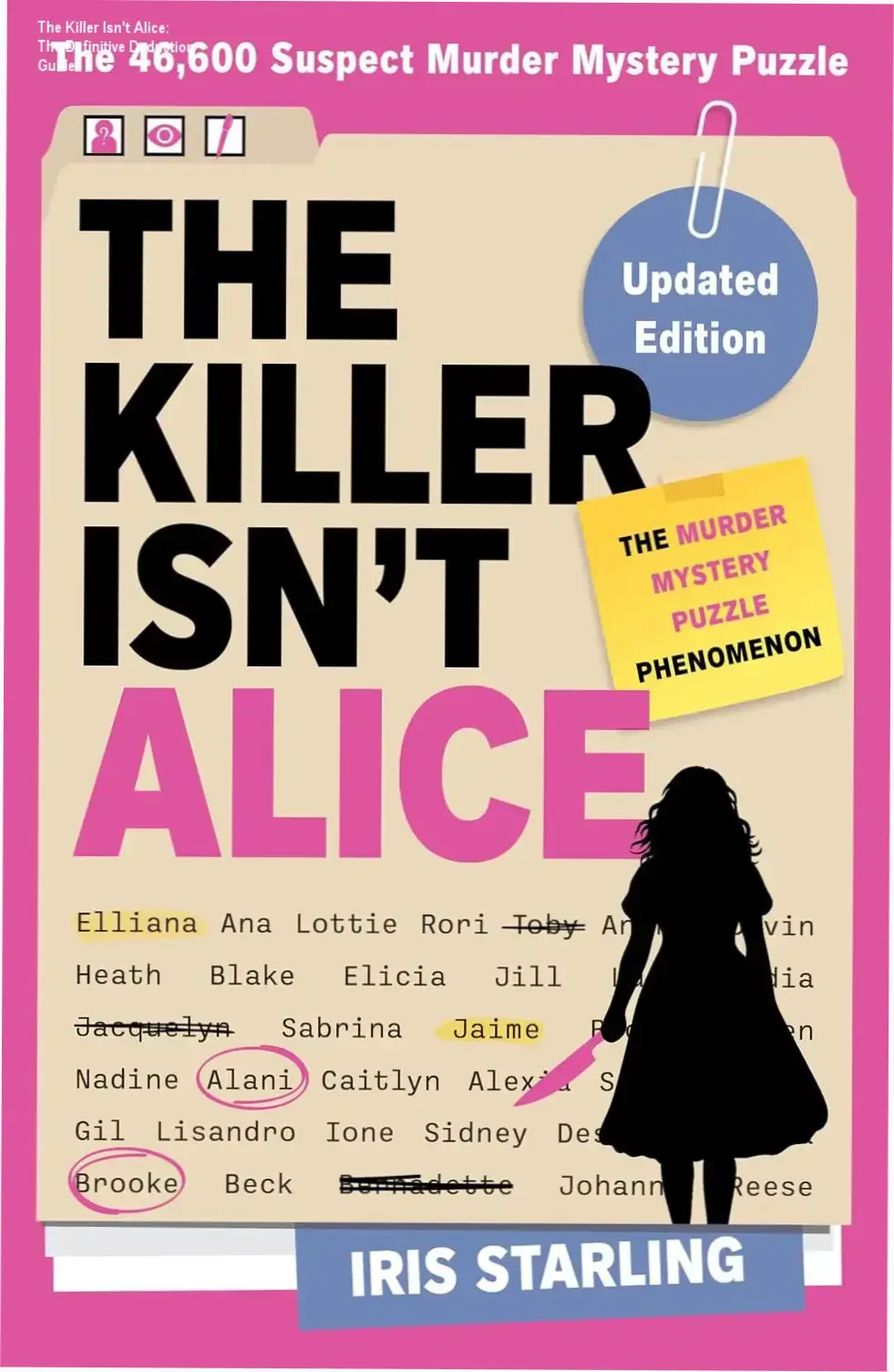
Most murder mysteries follow a predictable script: a brilliant detective notices a smudge on a rug, delivers a monologue, and solves the case while the reader just watches. It’s passive consumption, and for those of us who actually enjoy the thrill of the hunt, it’s often unsatisfying.
The shift toward “gamified” reading is a direct response to this boredom. The Killer Isn’t Alice attempts to flip the script by putting the actual detective work in your hands, transforming a narrative into a massive, high-stakes logic exercise.
Ready to dive into “The Killer Isn’t Alice”?
Explore available editions, check current live pricing, or download a free sample directly on Amazon.
Preview Free Sample & Check Price on Amazon
*You will be redirected to Amazon. As an Amazon Associate, we may earn from qualifying purchases.
The “46,600 Suspects” Gimmick: Math or Madness?
At first glance, the premise sounds like a marketing exaggeration. Who in their right mind wants to sift through 46,600 names? It sounds less like a book and more like a data entry job at a government office.
However, the brilliance of Iris Starling’s design isn’t in the reading, but in the elimination. You aren’t reading biographies of 46,000 people; you are applying filters to a dataset.
It functions like a complex SQL query for the brain. Each of the 18 clues acts as a filter. “The killer doesn’t have a vowel in their last name.” Boom. Thousands of names vanish instantly.
This isn’t a traditional whodunnit. It’s a test of patience and precision. If you miss one detail in clue #4, you’ll be chasing a ghost for the next fifty pages.
The Logic Engine and Pacing
The pacing of this book is entirely dependent on the reader’s cognitive speed. There is no narrative “flow” in the sense of chapters and plot twists. The “plot” is your own progress through the list.
The revised edition improves this significantly. The updated graphics make the scanning process less taxing on the eyes, which is crucial when you’re staring at columns of names for hours.
There is a specific psychological “hook” here: the dopamine hit of the narrow-down. Going from 10,000 suspects to 100 feels like a victory. Going from 100 to 1 is an obsession.
“It’s not a book you read; it’s a book you solve. The satisfaction comes from the methodical destruction of possibilities until only the truth remains.”
Expectation vs. Reality: A Warning to Novel Lovers
If you are looking for a deep dive into the psyche of Alice Starling or a richly textured atmospheric setting, you will be disappointed. This is not a novel.
The narrative framework—Alice being missing and leaving a folder of names—is merely the “skin” on a logic puzzle. The real meat is the deduction process.
Some readers on Reddit have complained that the story is thin. They are missing the point. The “story” is the act of solving the crime. The plot is the tool, not the destination.
It’s an interactive experience that demands a pen, a highlighter, and a level of focus that modern social media has stripped from most of us.
Technical Breakdown and User Experience
To understand if this fits your style, you need to look at the mechanics. It’s a process of attrition. You start with a sea of noise and end with a single signal.
| Feature | Analytical Verdict |
|---|---|
| Complexity | High (Requires extreme attention to detail) |
| Engagement | Addictive (Gamified progression) |