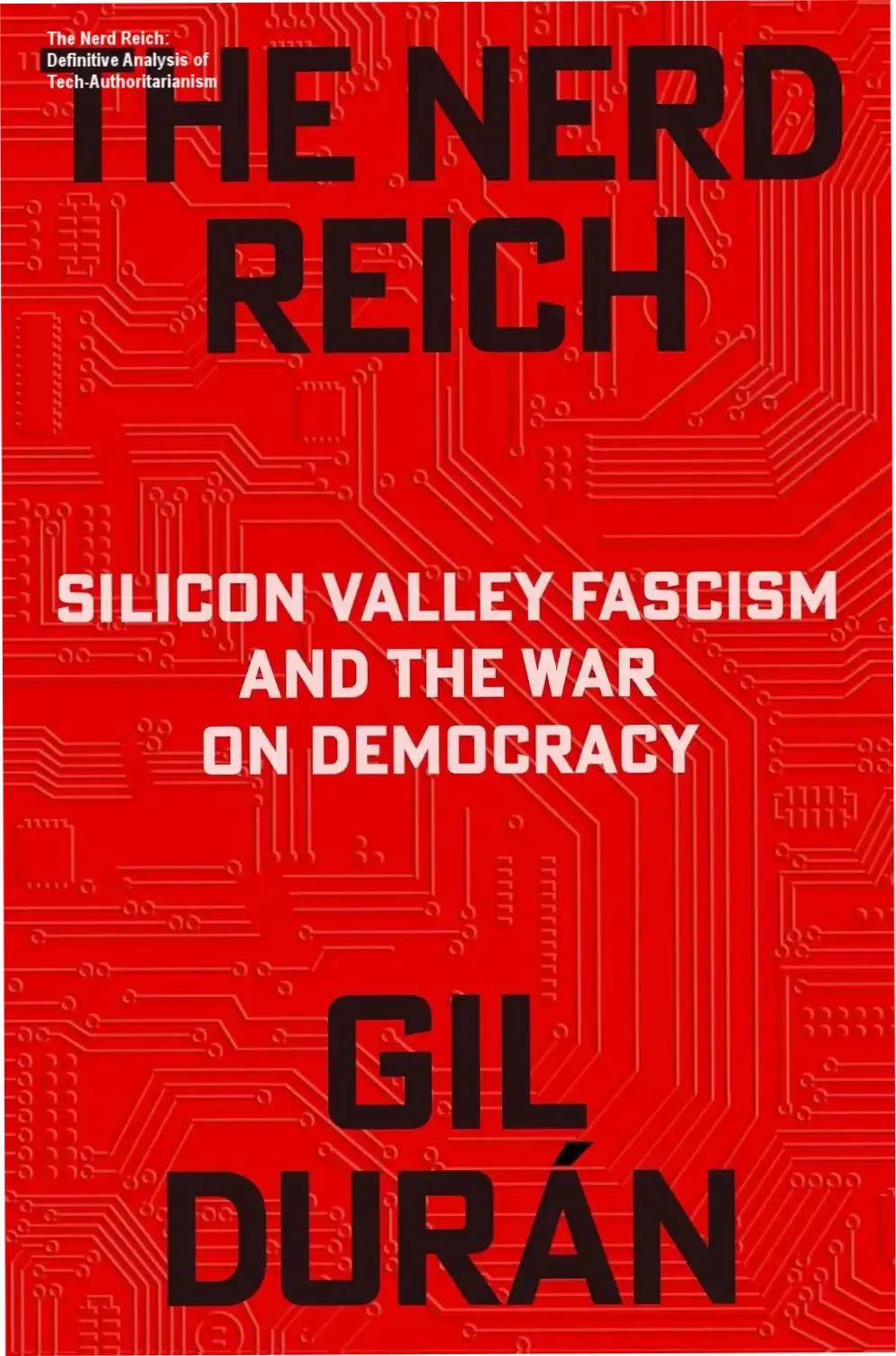
We have been conditioned to believe that “moving fast and breaking things” was simply a quirky startup mantra. We thought the disruption was limited to how we hail rides or order food. But what happens when the thing being broken isn’t a legacy industry, but the democratic process itself?
Gil Durán’s The Nerd Reich strips away the veneer of “innovation” to expose a calculated play for global power. It is not a conspiracy theory; it is a documented blueprint. If you have felt the creeping shift toward algorithmic governance, you can check the availability and reader reception of this analysis on Amazon to see how it is landing with those tracking the tech-authoritarian rise.
Ready to dive into “The Nerd Reich”?
Explore available editions, check current live pricing, or download a free sample directly on Amazon.
Preview Free Sample & Check Price on Amazon
*You will be redirected to Amazon. As an Amazon Associate, we may earn from qualifying purchases.
The Intellectual Architecture of Digital Feudalism
Durán doesn’t start with the headlines; he starts with the philosophy. The book traces the current tech-authoritarian movement back to a specific, ominous text: The Sovereign Individual by James Dale Davidson and Lord William Rees-Mogg.
For the uninitiated, this isn’t just a book about wealth. It is a manifesto for the escape of the elite from the “social contract.” Durán argues that the billionaires we see today are not merely eccentric; they are disciples of a worldview that views the nation-state as an obsolete obstacle.
The core argument is chillingly direct: replace elected officials with corporate rule. In this framework, the “citizen” is downgraded to a “user,” and the “law” is replaced by “code.” If you can control the algorithm, you control the reality of the populace without ever needing to win an election.
| Key Concept | Democratic Model | “Nerd Reich” Model |
|---|---|---|
| Governance | Legislative consensus | Algorithmic dictate |
| Power Source | Popular vote | Capital & Code |
| Citizen Status | Rights-bearing individual | Data-producing user |
| Goal | Social stability/Equity | Technocratic efficiency/Control |
The Apostles of the New Order
The book shines when it moves from theory to the “apostles.” Durán focuses on the inner circle: Peter Thiel, Marc Andreessen, Balaji Srinivasan, and Elon Musk. He avoids the trap of treating them as mere “bosses.”
Instead, he analyzes them as political architects. The narrative explores how these men have leveraged cryptocurrency, AI, and social media not as tools for liberation, but as infrastructure for a new kind of feudalism.
Durán’s reporting on the “weaponized elections” in San Francisco serves as a microcosm. He shows how billionaires used local politics as a beta test for larger, national strategies. It is a masterclass in showing how “innovation” is often a euphemism for “circumventing the law.”
“Democracy is being dismantled not by coups or tanks, but by code, capital, and the illusion of innovation.”
Writing Style: Urgency vs. Evidence
Durán writes with the urgency of a whistleblower and the precision of a seasoned journalist. The pacing is relentless. He doesn’t waste time with academic fluff; he goes straight for the jugular of the tech-elite’s ambitions.Who Should Actually Read This?
The Nerd Reich isn’t a beach read. It’s a dense, investigative autopsy of power. It is designed for a specific profile of reader:
- The Tech-Skeptic: If you suspect that “disruption” is often a euphemism for “dismantling public oversight,” this book provides the intellectual ammunition you’ve been looking for.
- Political Analysts: Those tracking the shift from traditional conservatism to “techno-authoritarianism” will find Durán’s mapping of the influence from The Sovereign Individual to current White House dynamics essential.
- The AI-Anxious: Readers who want to understand how LLMs and algorithms aren’t just tools, but political weapons used to engineer social consent.
Who Should Skip It?
Avoid this book if you are looking for a celebratory biography of Silicon Valley “visionaries.” If you believe that billionaire philanthropy is the primary driver of human progress, Durán’s cynical—yet evidence-backed—deconstruction of Peter Thiel and Elon Musk will likely frustrate you.
Additionally, skip this if you want a “quick-start guide” to cryptocurrency or AI. This is a political treatise, not a technical manual. Expect a narrative on power and control, not a tutorial on blockchain.
Value for Money: Reality Check
At 352 pages, the book offers a high information-to-page ratio. You aren’t paying for fluff; you’re paying for an insider’s synthesis of how “digital feudalism” actually operates.
The primary risk for the buyer is expecting a surface-level critique. This is a deep dive. The value lies in the connectivity of ideas—how a 1990s philosophical text became the blueprint for 2020s governance. If you value systemic analysis over anecdotal gossip, the investment is justified.
Editorial Verdict
Gil Durán has written a cautionary tale that feels less like a book and more like a warning siren. While some may find the “fascism” framing provocative, the evidence regarding the replacement of elected officials with corporate interests is hard to ignore. It is a sobering look at a world where code replaces law.
For those who want to see the actual machinery behind the current political upheaval, we suggest checking the latest reader reviews and pricing on Amazon to see if this perspective aligns with your current research.
Final Editorial Verdict
“The Nerd Reich” delivers on its core promise for its intended audience, offering compelling insights without fluff. As highlighted in our detailed edition breakdown, its practical depth and readability are its greatest strengths.
We also recommend checking the official Kindle sample and reader ratings before making your final purchase decision.
*You will be redirected to Amazon. As an Amazon Associate, we earn from qualifying purchases.