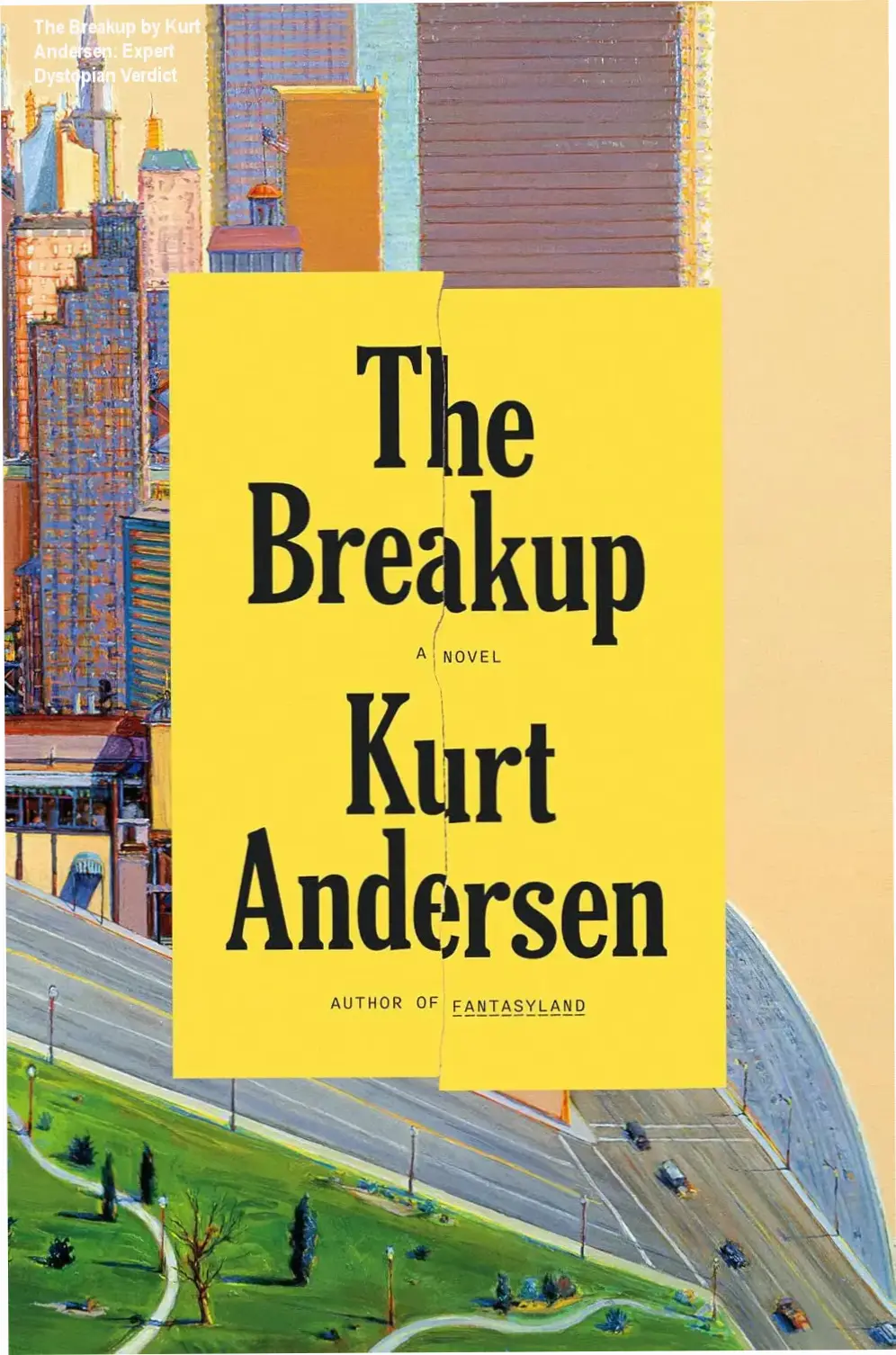
Kurt Andersen has spent decades dissecting the American susceptibility to fantasy, but The Breakup feels less like a diagnosis and more like an autopsy performed on a body that is still breathing. The central conceit—a marriage dissolving in lockstep with the nation’s balkanization—is a literary device as old as Lincoln, yet Andersen updates it with a very specific, very modern anxiety: the algorithmic curation of reality. We don’t just disagree on politics anymore; we inhabit different data streams. The novel posits a 2045 where the “civil war” of the 2030s didn’t end with a surrender at Appomattox, but with a divorce decree drawn along state lines. If you have ever looked at a partner, a parent, or a lifelong friend and felt the unbridgeable chasm of separate information universes, this premise hits uncomfortably close to home. You can check the current edition and reader reception here to see how this speculative leap lands for others.
The speculative machinery is dense. Andersen builds a “Free American Republic” in the interior and a rump United States on the coasts, separated not just by borders but by divergent technological evolutions. AI isn’t just a background hum; it’s the mediator of memory, the architect of truth, and the third party in every argument. The road trip structure—Natalie and Asher touring colleges with their son—forces intimacy inside a pressure cooker. It’s a clever way to stage the “state of the union” address without a single podium. The risk, always, is that the metaphor eats the characters. Early reader sentiment on Goodreads suggests Andersen mostly avoids this trap, keeping the domestic grief sharp enough to cut through the world-building.
Ready to dive into “The Breakup: A Novel”?
Explore available editions, check current live pricing, or download a free sample directly on Amazon.
Preview Free Sample & Check Price on Amazon
*You will be redirected to Amazon. As an Amazon Associate, we may earn from qualifying purchases.
The Architecture of a Fractured Union
Andersen doesn’t just give us a map; he gives us a legal framework. The “Velvet Divorce” (a term borrowed from Czechoslovakia, deployed here with heavy irony) is the backdrop, but the foreground is the custody battle for shared history. Natalie lives in the FAR—rural, religious, restrictive, but arguably grounded in a brutal physical reality. Asher remains in the coastal US—technocratic, fluid, mediated by AI “agents” that smooth over friction. The asymmetry is deliberate. The FAR feels like a reactionary fortress; the US feels like a fragile simulation. This imbalance drives the narrative tension. It prevents the “both sidesism” that often plagues political fiction. One side has the drones; the other has the land.
The world-building extends to the texture of daily life. In San Francisco, Asher navigates a city where “consensus reality” is a subscription service. In Tennessee, Natalie contends with a theocratic bureaucracy that polices biology. Their seventeen-year-old son, Theo, is the citizen of nowhere, holding passports for both. He is the only character who must synthesize the split. Readers on early Amazon threads have noted the “Theo chapters” are the most emotionally resonant precisely because he refuses the binary. He hacks the border. He dates across the line. He treats the geopolitical catastrophe as a logistical annoyance. It’s a very Gen Z/Alpha response: adapt, route around, survive.
Prose Style: Satire as a Defense Mechanism
If you know Andersen’s non-fiction (Fantasyland, Evil Geniuses), you know the voice: erudite, sardonic, densely allusive. That voice is here, but filtered through close third-person perspectives. The satire lands hardest in the neologisms. “Truth-optional zones.” “Sentience-as-a-service.” “The Great Unfriending.” These aren’t just cute labels; they function as cognitive shortcuts for the reader, collapsing complex sociological shifts into punchlines. The pacing mimics the road trip: long stretches of interior monologue and landscape description punctuated by violent, surreal encounters—a checkpoint standoff, a deepfake ambush, a revival meeting that looks suspiciously like a product launch.
However, the density is a barrier. At 576 pages, the novel demands patience. The first hundred pages are heavy on exposition, delivered through dialogue that occasionally creaks under the weight of “As you know, Bob” syndrome. Andersen trusts the reader to assemble the timeline—the 2030s war, the secession treaties, the AI alignment crisis—from fragments. Some verified purchasers have flagged this as a “slow start.” It’s not a thriller. It’s a novel of ideas wearing a road-trip skin. If you want plot mechanics, look elsewhere. If you want a systems-level analysis of how a culture loses the ability to agree on facts, the slow burn is the feature.
The Marriage as Microstate
This is where the book justifies its existence. The geopolitics are the set dressing; the marriage is the engine. Natalie and
Who Should Read This (And Who Should Skip It)
This novel lands squarely for readers who appreciate speculative fiction grounded in domestic realism. If you enjoyed the societal texture of Station Eleven or the political fracture in American War, Andersen’s prose will feel familiar—sharp, observant, and unafraid of intellectual heft. It suits the reader who wants a “state of the union” address delivered through a marriage, not a manifesto.
Skip it if you need plot velocity. The narrative moves at the pace of a marriage counseling session: circular, repetitive, occasionally stalled. There are no action set pieces. The “civil war” backdrop is largely off-page, referenced through dialogue and atmosphere rather than depicted. Readers expecting a dystopian thriller based on the marketing tags will feel misled. This is literary fiction wearing a near-future coat.
Value Proposition: Hardcover vs. Library Hold
At 576 pages, the physical hardcover is a commitment—both in shelf space and wrist strain. The print quality from Random House is standard trade: decent paper, tight binding, but nothing archival. Given the publication date (August 2026), early adopters pay a premium for immediacy. The Kindle edition offers better value for a single read-through; the prose density benefits from searchable highlights and adjustable leading.
Library acquisition is the smart play for the undecided. The re-read value hinges entirely on how much you want to dissect the AI-integrated world-building details on a second pass. Most readers will extract the thematic marrow in one go.
Common Buying Missteps
- Expecting a “How America Splits” manual: The geopolitical mechanics (Free American Republic vs. rump USA) are backdrop texture, not world-building bible. Don’t buy for the lore.
- Confusing “AI-suffused” with Sci-Fi: The tech is mundane—assistants, filters, surveillance normalization. It’s background radiation, not the plot engine.
- Buying for the “Hopeful” tag: The hope is quiet, ambiguous, and hard-won. It is not a comforting resolution.
Quick Contextual FAQ
Is it necessary to read Fantasyland first? No. Andersen’s non-fiction argues the thesis; this novel dramatizes the symptoms. They complement but don’t require each other.
How graphic is the civil war content? Restrained. Trauma is discussed, not displayed. The violence is psychological and structural.
Does the road trip structure pay off? Structurally, yes. It forces proximity. Narratively, some encounters feel like thematic checklists (the tech billionaire, the separatist farmer, the neutral zone academic).
Editorial Bottom Line
The Breakup is a significant, flawed achievement. It diagnoses the fracture better than it sutures the wound. The marriage metaphor occasionally groans under the allegorical weight, and the final act trades ambiguity for a clarity the novel hasn’t fully earned. Yet the sentence-level intelligence, the refusal to villainize either spouse (or either polity), and the eerily plausible texture of 2045 daily life make it essential reading for the current moment. It respects your intelligence enough to frustrate you. Check current pricing and reader sentiment here.
Final Editorial Verdict
“The Breakup: A Novel” delivers on its core promise for its intended audience, offering compelling insights without fluff. As highlighted in our detailed edition breakdown, its practical depth and readability are its greatest strengths.
We also recommend checking the official Kindle sample and reader ratings before making your final purchase decision.
*You will be redirected to Amazon. As an Amazon Associate, we earn from qualifying purchases.