
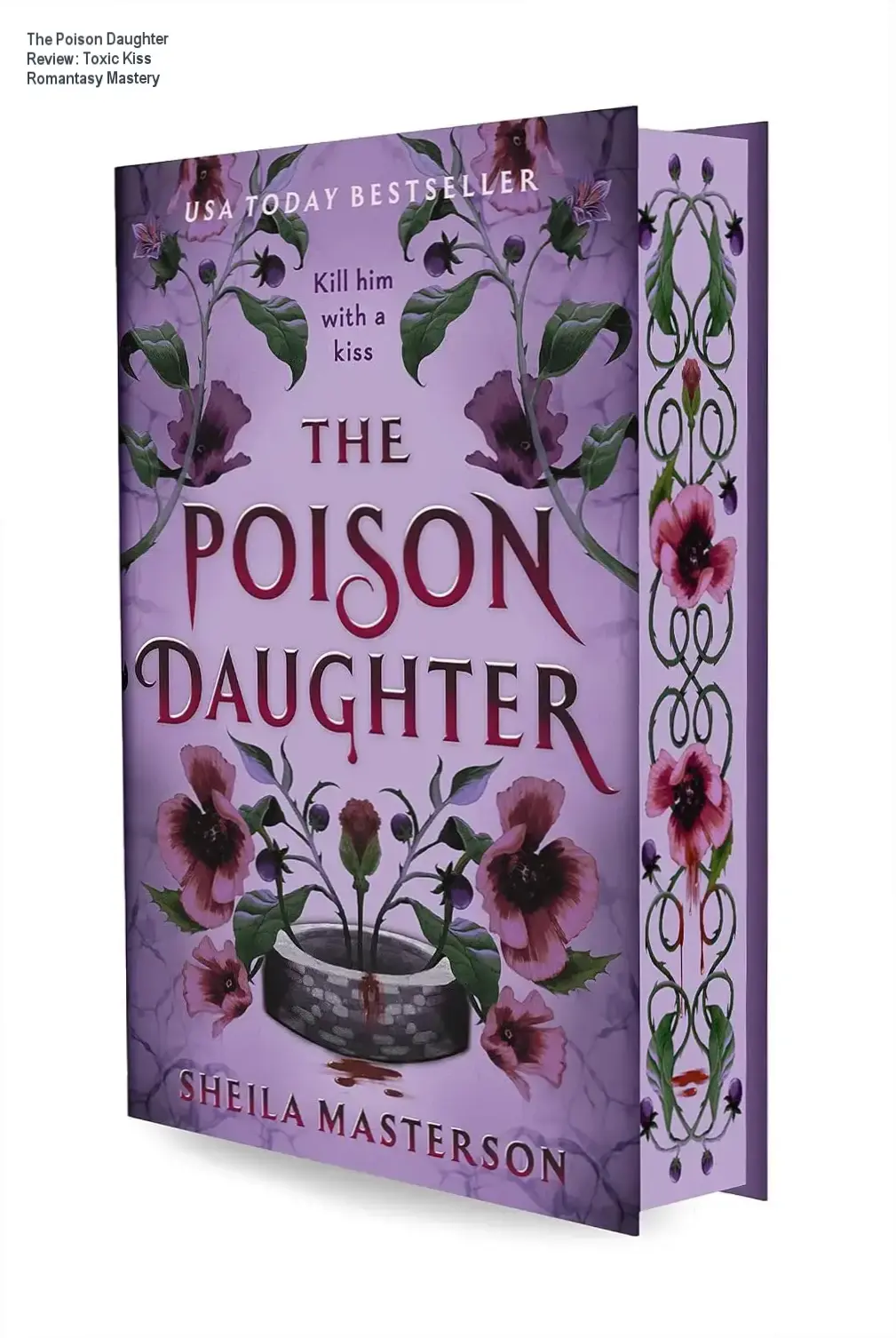
Romantasy readers have a complicated relationship with the “lethal touch” trope. It often promises high stakes but delivers a convenient magic system that evaporates the moment the plot requires intimacy. Sheila Masterson’s The Poison Daughter arrives with significant hype—60,000+ Amazon ratings and a #1 Best Seller badge in Enemies to Lovers—and it immediately distinguishes itself by refusing to let Harlow Carrenwell off the hook. Her lips don’t just kill; they define her existence as a weapon wielded by a corrupt family. The central tension isn’t just “will they kiss,” it’s “how does a woman who equates intimacy with murder navigate a marriage of inconvenience to a man who survives her?” If you are tracking the current shift toward morally grey female protagonists who channel feminine rage into structural violence, this is the benchmark. You can check the current reader reception and edition details right here.
The marketing leans heavily on the “sprayed edges” and bonus chapter, but the substance lies in the dual POV structure. Henry Havenwood isn’t just the immune love interest; he is a strategic enigma from a family that vanished years ago. The forced proximity inside a fortress surrounded by vampire-infested woods creates a pressure cooker that Masterson manages with surprising restraint. It avoids the “instalove” trap by grounding the attraction in mutual suspicion and tactical maneuvering. The vigilante subplot—Harlow hunting abusive men—adds a layer of cathartic justice that resonates deeply with current discourse on agency and protection, elevating the romance from mere escapism to a commentary on power dynamics.
Ready to dive into “The Poison Daughter”?
Explore available editions, check current live pricing, or download a free sample directly on Amazon.
Preview Free Sample & Check Price on Amazon
*You will be redirected to Amazon. As an Amazon Associate, we may earn from qualifying purchases.
Writing Style, Pacing, and the “Slowburn” Promise
Masterson writes with a visceral immediacy. The prose is sharp, favoring sensory details— the taste of poison, the texture of sprayed edges on the physical page, the humid rot of the vampire woods—over flowery exposition. At 672 pages, the “Slowburn” publisher imprint name is a warning label, not just branding. The first 150 pages are deliberate. We sit in Harlow’s headspace: the mechanics of her kiss, the choreography of her vigilante kills, the suffocating dynamic with her parents.
Some readers on Goodreads flagged this opening act as “slow,” but that criticism misses the architectural purpose. Masterson is building the cage before she rattles the bars. The pacing accelerates violently once Henry enters the household. The “enemies to lovers” beat doesn’t happen in a ballroom; it happens over corpses, interrogations, and late-night strategy sessions. The dual POV is essential here. Without Henry’s perspective, his immunity looks like a plot device. With it, his immunity becomes a mystery he is equally desperate to solve.
The dialogue crackles. It avoids the anachronistic slang that plagues the genre. Harlow speaks like a woman who has killed hundreds: precise, guarded, darkly funny. Henry matches her. Their banter functions as verbal sparring—foreplay for people who cannot touch. A Reddit thread on r/FantasyRomance highlighted a specific exchange in Chapter 14 where they negotiate the terms of their “marriage” like a hostage negotiation. That scene encapsulates the book’s strength: romance as high-stakes diplomacy.
Core Narrative Structure: Vigilante Justice Meets Political Intrigue
The narrative operates on three distinct tracks that braid together tighter than expected. Track one: The Vigilante. Harlow’s “moonlighting” isn’t a side quest; it’s the only time she has agency. She targets men the law protects. This resonated heavily with verified Amazon reviewers, many citing the “catharsis” of the opening kill sequence. It establishes her moral code immediately: she is a monster who protects the vulnerable.
Track two: The Family Rot. The Carrenwells are the true villains. They are not cartoonish; they are terrifyingly pragmatic aristocrats who view their daughter as a reusable asset. The “first husband in the ground” backstory isn’t backstory—it’s trauma fuel. The parents’ casual cruelty (“annihilate their opposition”) makes Harlow’s rebellion inevitable.
Track three: The Havenwood Mystery. Why did they return? Why is Henry immune? The vampire-infested woods (the “Weald”) act as a hard magic boundary. The vampires aren’t romantic leads; they are environmental hazards and political leverage. The mystery resolves in a third-act reveal that recontextualizes the entire magic system. It’s not a “chosen one” prophecy; it’s a bloodline contract with fine print. That grounded approach to fantasy lore—magic as law and biology—earned specific praise in critical reviews for avoiding “chosen one” fatigue.
| Element | here.
Final Editorial Verdict“The Poison Daughter” delivers on its core promise for its intended audience, offering compelling insights without fluff. As highlighted in our detailed edition breakdown, its practical depth and readability are its greatest strengths. We also recommend checking the official Kindle sample and reader ratings before making your final purchase decision. *You will be redirected to Amazon. As an Amazon Associate, we earn from qualifying purchases.  Related Posts


|
|---|