
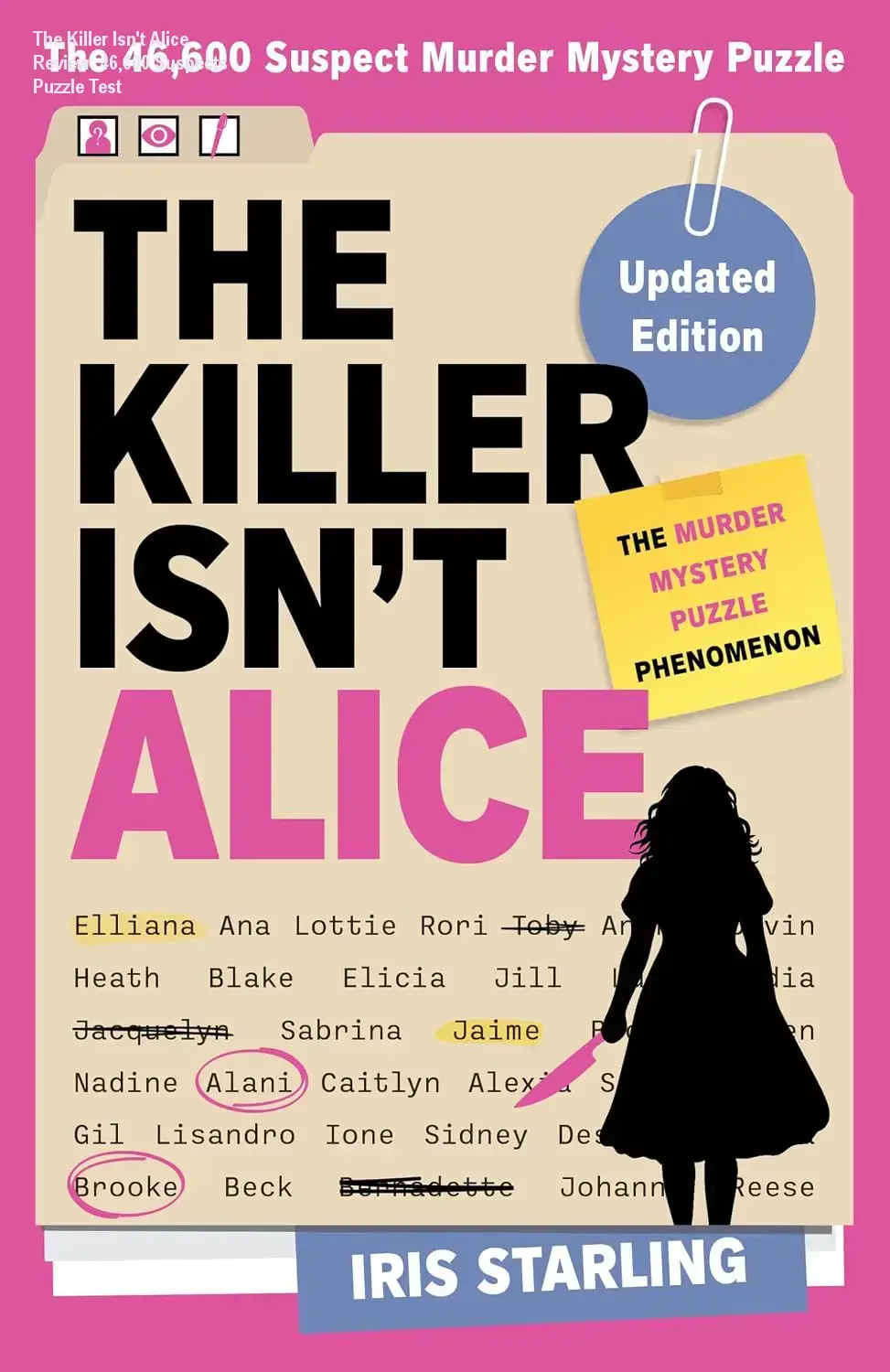
Most modern “mysteries” are predictable. You read a few chapters, spot the obvious red herring, and guess the killer before the halfway mark. The thrill is gone because the narrative does the heavy lifting for you, leading you by the hand toward a curated conclusion.
Then comes a concept like “The Killer Isn’t Alice.” It doesn’t offer a story in the traditional sense; it offers a data set. It transforms the reader from a passive observer into a forensic accountant of crime. If you’ve ever felt that digital puzzle games are too guided or that traditional novels are too slow, checking the current reader reception of this logic sensation reveals a shift toward “gamified” literature where the reward isn’t the ending, but the process of elimination.
Ready to dive into “The Killer Isn’t Alice”?
Explore available editions, check current live pricing, or download a free sample directly on Amazon.
Preview Free Sample & Check Price on Amazon
*You will be redirected to Amazon. As an Amazon Associate, we may earn from qualifying purchases.
The Architecture of Exhaustion: 46,600 Suspects
Let’s be honest: the number 46,600 is designed to intimidate. It’s a marketing hook. In a standard novel, a huge cast of characters is a flaw; here, it’s the core mechanic.
The book functions less like a story and more like a massive spreadsheet. You are given a folder of names and 18 clues. Your job is to apply these filters methodically.
It’s a brutal exercise in patience. You aren’t looking for “motives” or “emotional breakthroughs.” You are looking for a specific set of attributes that only one person in a sea of thousands possesses.
For some, this is a nightmare. For the logic-obsessed, it’s a sanctuary. It strips away the fluff of dialogue and pacing, leaving only the raw satisfaction of deduction.
Logic vs. Narrative: The Great Trade-off
If you are looking for a character study of Alice Starling, you are in the wrong place. Alice is the catalyst, not the focus. The “protagonist” is actually your own cognitive ability.
The pacing is entirely dependent on your speed of analysis. There is no “slow middle” because the tension is generated by the shrinking list of suspects.
This creates a unique psychological loop. Each clue eliminated feels like a small victory. The “grind” becomes the game.
“It’s not a book you read; it’s a puzzle you solve. The narrative is just the wrapper for a high-stakes game of ‘Who is Left?'”
However, the risk here is boredom. If the clues are too simple, the process becomes clerical work. If they are too obscure, it becomes frustrating. Iris Starling seems to have found a balance that keeps the “detective” brain engaged.
The Reader’s Scorecard: Technical Breakdown
To understand if this fits your reading style, we have to look at the “friction” of the experience. This isn’t a beach read.
| Metric | Rating | Analysis |
|---|---|---|
| Mental Load | Extreme | Requires active note-taking and intense focus. |
| Pacing | User-Driven | As fast or slow as your ability to cross off names. |
| Innovation | High | Blurs the line between a book and a logic game. |
| Accessibility | Medium |
Who Is This Actually For?This isn’t a novel. If you’re looking for character arcs, atmospheric prose, or a twisty plot, you’re in the wrong place. The Killer Isn’t Alice is a logic engine disguised as a book. The ideal reader is someone who finds peace in spreadsheets, loves the “process of elimination” in Sudoku, or enjoys the meticulous grind of a complex data set. It appeals to the analytical obsessive—the person who doesn’t want to be told the answer, but wants to prove they can find it through sheer persistence. The “Hard Pass” ListYou should probably skip this book if:
Value Analysis: Game or Book?Evaluating this as a “book” is a mistake. Evaluate it as a single-player analog game. From that perspective, the value is high. You aren’t paying for 224 pages of text; you’re paying for a curated logic challenge that provides hours of cognitive engagement. The biggest purchasing misstep is expecting a traditional mystery. If you buy this thinking it’s a “whodunnit” novel, you’ll feel cheated. If you buy it as a mental gymnasium, it’s a bargain. Editorial ConclusionIris Starling has created a hybrid experience that strips the mystery genre down to its barest bones: evidence and elimination. It is rigorous, unapologetically demanding, and deeply satisfying for those who actually solve it. It transforms the reader from a passive observer into an active investigator. While the scale (46,600 suspects) seems daunting, the elegance lies in the system of elimination. To see if the community’s success rate matches the hype, we suggest checking the verified reader reviews on Amazon. Final Editorial Verdict“The Killer Isn’t Alice” delivers on its core promise for its intended audience, offering compelling insights without fluff. As highlighted in our detailed edition breakdown, its practical depth and readability are its greatest strengths. We also recommend checking the official Kindle sample and reader ratings before making your final purchase decision.  Related Posts

|